
Diving Deeper into Play and Constructivism
What exactly is play and constructivism?
Play
There are many definitions of play across the early childhood industry. To me,
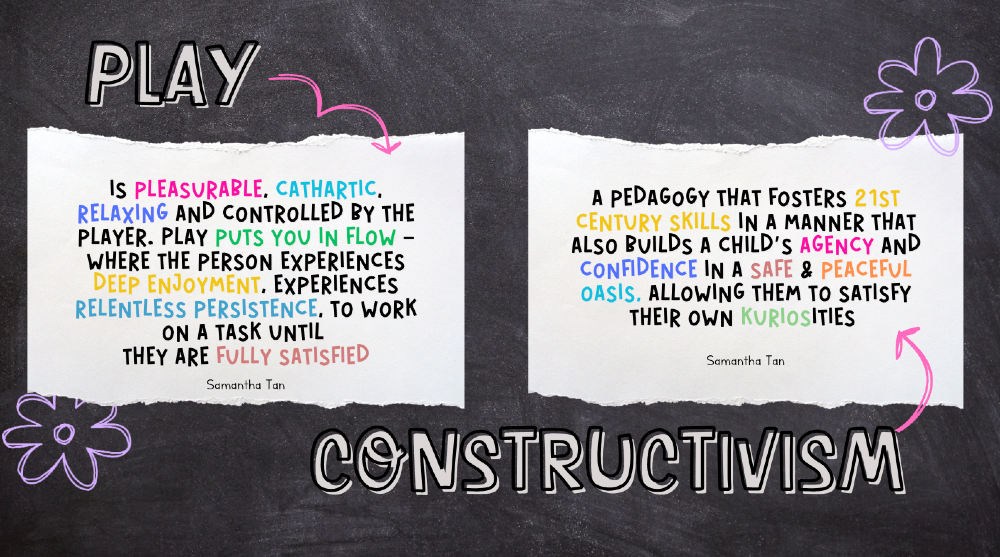
Play is pleasurable, cathartic, relaxing and controlled by the player. Play puts you in flow – where the person experiences deep enjoyment, experiences relentless persistence, to work on a task until they are fully satisfied (Csikszentmihalyi, 1990).
As written and researched on, there are many benefits of play – it fosters cognitive thinking, helps children gather information and create new ideas (Bergens, 1998), it is also a way for children to build on their language development, and is also beneficial towards their social and emotional development.
We were all born to be curious about the world around us and that we’re innately joyful (or at least we’re meant to be). The combination of these two traits make a playful spirit, and it is because of this innate playful spirit that we are drawn to playing as children. We play to make sense of the world around us. In infancy, we repeat certain things and find joy in discovering new things (call it schemas or enjoying cause-and-effect), repeat play is driven out of curiosity and the satisfaction that comes with building on our understanding of the world. As we get older, we learn new ways to communicate, we learn new things from our play when we are younger and we become better thinkers.
Constructivism
Constructivism is a pedagogy that fosters 21st century skills in a manner that also builds a child's agency and confidence in a safe and peaceful oasis, allowing them to satisfy their own curiosities.
In my diploma years, preschool education was rather basic. We focused on the (then) 6 domains of learning: language and literacy, numeracy, creative expression and the arts, discovery of the world (essentially means science), social and emotional development and motor skills development. Teaching was rather didactic, teacher-centric. Children felt like passive learners to me, but it didn't quite bother me because I thought i was still doing good work with encouraging them to learn in playful ways. It was only in university that I had to unlearn what i thought was the best way to teach and embrace constructivism and the emergent curriculum. The difference was remarkable. Curriculum integration is important in supporting children with making connections across their experiences, but it does not look like this:
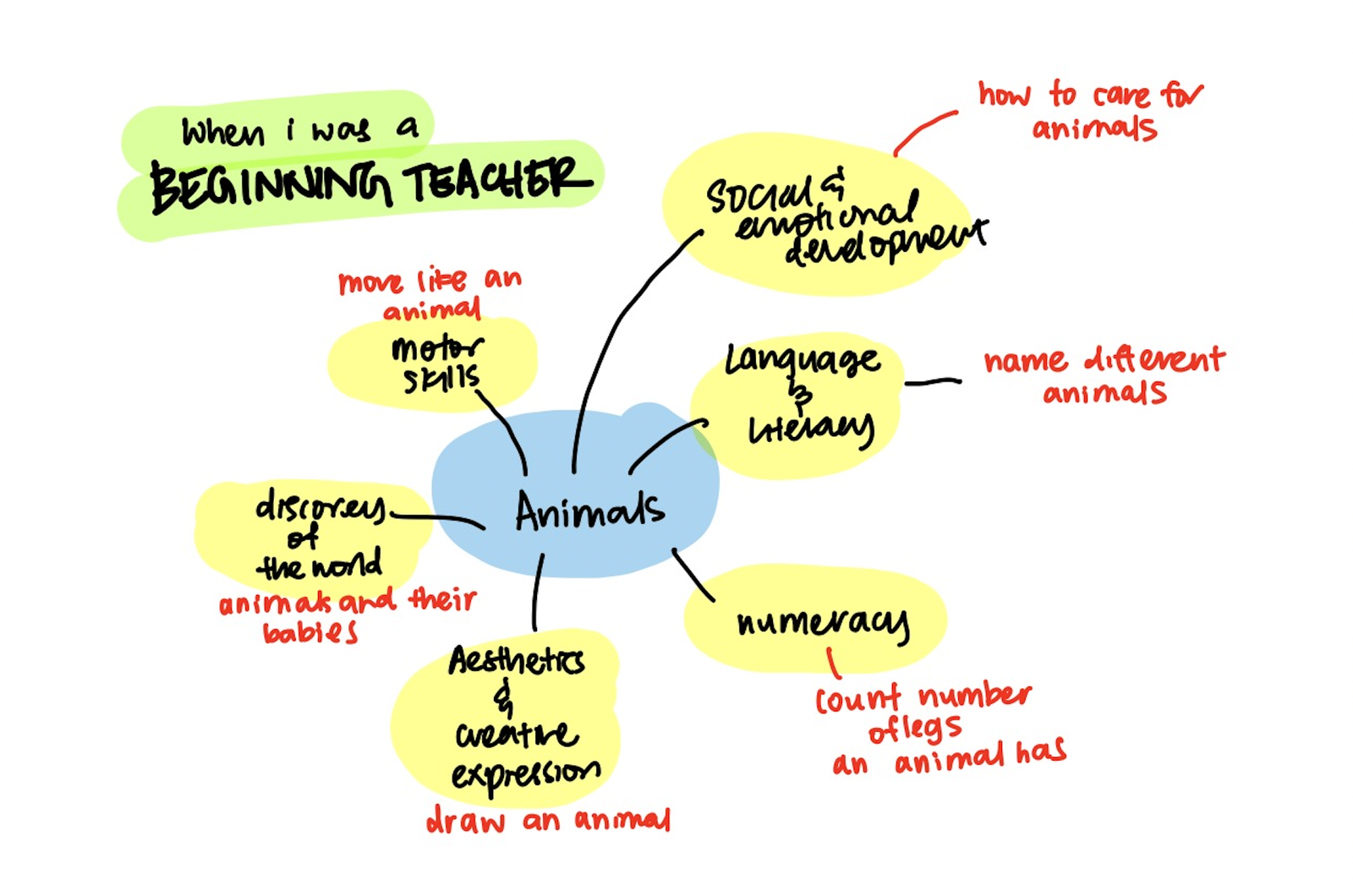
Teacher Sam's Maps in 2015
If the objective of my lesson is to draw an animal, count the number of legs an animal has, name the animal, what have i truly learned about the animal? I started to think about Big Ideas, Constructivism and the Emergent Curriculum in university and now, I can never find satisfaction in teacher-directed, traditional, subject-based curriculums.
The major features of the educational progressive philosophy are, firstly, that the child learns best when he has a genuine interest in the topic of study. Secondly, that learning through rote memory is useless to children. Thirdly, that teachers should be aware of the holistic development of children and attentive to children’s needs. Lastly, that children learn best when they have direct contact with the material (by material, i don't mean just flash cards and figurines, but actual real life experiences).
My curriculum maps now look a little more like this:
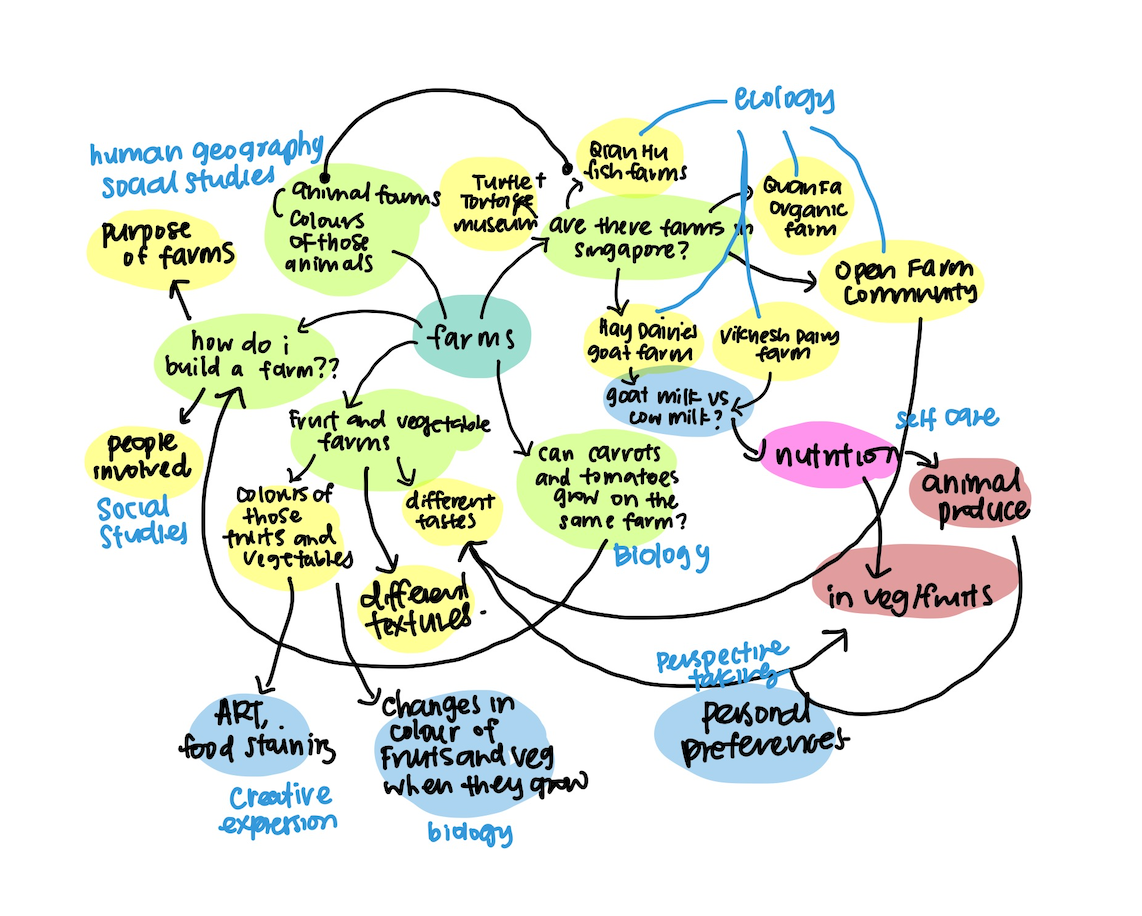
Teacher Sam's Maps as of 2024
A curriculum anchored on constructivism is a curriculum that emerges out of children’s interests. Being focused on the topics of study that children are genuinely interested in will increase their level of engagement and understanding of the topic. In such a curriculum, the child is seen as a curious and powerful learner who is fully capable of constructing his or her own knowledge through experience!
What are 21st century skills then? Does that mean you disregard primary school preparation?
Some 21st century skills are leadership, entrepreneurial skills, which can all be achieved as critical thinking dispositions are fostered. That includes flexible thinking, reflective thinking, curious thinking, persistence and children's collaborative outlook. Children begin to develop a genuine love for lifelong learning, and i believe that those are the best things you can equip your children with for primary school.
Ultimately, constructivist education, emergent curriculums are more natural ways of meaning-making and learning in children as opposed to the traditional teacher-directed method of teaching. I saw the power in this form of learning, I felt the joy and desire to learn when children were given the opportunity to satisfy their curiosities.
I'm so excited to be starting play projects with smaller groups of children come July 2024. For now, please keep a look out for my play projects on @kuriosoasis, where I attempt to make learning through this pedagogy visible to you, and follow @askteachersam for more early childhood content! Thank you for taking the time to read this lengthy post, thank you for being curious about what I love.
Teacher Sam <3
